Why are orange cats usually male?
Orange cats are usually male because the gene for orange fur sits on the X chromosome. A male cat has one X chromosome, so a single copy of the orange version makes him orange all over. A female has two X chromosomes and needs the orange version on both to be fully orange; with just one copy she becomes a tortoiseshell or calico instead. In 2025 two research teams finally identified that gene: a small deletion of DNA near a gene called ARHGAP36.
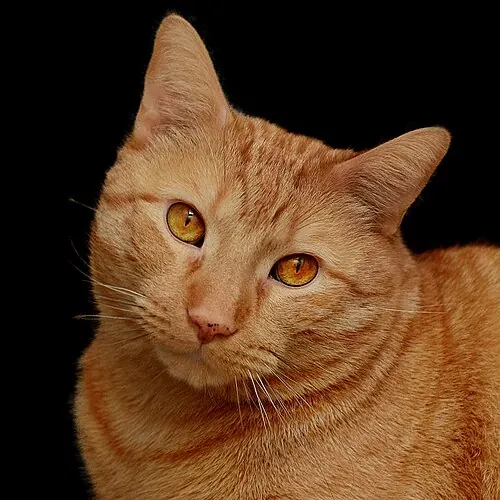
How does an X linked gene make orange cats mostly male?
Breeders call it the Sex linked orange gene, written as O. Because it is on the X chromosome, the arithmetic is different for each sex. A male (XY) is orange if his one X carries O. A female (XX) is fully orange only if both of her X chromosomes carry it, which needs an orange gene from her mother and from her father. If the orange version is uncommon in a population, getting it twice is much less likely than getting it once, so fully orange females turn up less often than orange males. This is a pattern, not a rule: orange female cats are perfectly normal, just less common.
Why are tortoiseshell and calico cats almost always female?
A female with one orange X and one non orange X gets a patchwork coat. Early in development each cell in a female embryo switches off one of its two X chromosomes at random, and every cell descended from it keeps the same one switched off. Patches where the non orange X is silenced grow orange fur; patches where the orange X is silenced grow black or brown fur. That patchwork is a tortoiseshell. A calico has the same mix plus large areas of white, which come from a separate white spotting gene. The Stanford team notes that these cats helped inspire Mary Lyon's original 1961 theory of X inactivation.
Male tortoiseshell and calico cats do exist, but rarely, and they usually have an unusual set of sex chromosomes. A 2026 case report and literature review in the journal Sexual Development described a Maine Coon tomcat whose tortoiseshell coat came from a mix of XX and XY cells in his body, and noted that such males can sometimes be fertile, which surprised breeders who assumed they were all sterile.
What is the orange gene, and why did it take so long to find?
For decades scientists knew where the orange gene was on the X chromosome but not what it was. In most mammals, red or yellow fur comes from changes in a gene called MC1R, but orange cats have a normal MC1R, which made the cat version a puzzle. In May 2025 two teams published in the same issue of Current Biology:
- A group led by Hidehiro Toh and Hiroyuki Sasaki at Kyushu University found a deletion of about 5.1 kilobases inside the ARHGAP36 gene that was closely and exclusively associated with orange coloring. Skin from orange areas showed ARHGAP36 activity linked with lower activity of many genes that make dark pigment.
- A team led by Greg Barsh at Stanford University, with first author Christopher Kaelin, found the same roughly 5 kb deletion and showed it was perfectly matched with orange coat color in 188 extra cats they tested (145 orange, 6 calico or tortoiseshell and 37 non orange).
Both teams concluded that the deletion removes a stretch of DNA that normally keeps ARHGAP36 quiet in pigment cells.
How does that deletion turn fur orange?
Pigment cells in hair follicles can make two kinds of melanin: dark eumelanin (black or brown) and pale pheomelanin (red or yellow). Switching between them depends on a signaling chain that runs through an enzyme called protein kinase A. The Stanford team found that in orange cats, ARHGAP36 is switched on specifically in hair follicle pigment cells, where in non orange cats it was not detectable. There it lowers the levels of protein kinase A, so the cells stop making much dark pigment and make the orange kind instead. Because the change acts further down the chain than MC1R, it explains why cats can be orange with a normal MC1R. The authors suggest this unusual mechanism may also explain why calico dogs, mice and other mammals are not seen.
How old is the orange cat mutation?
The Stanford team found that all the orange cats in their dataset shared a common stretch of DNA around the deletion, which points to a single origin. Orange coloring is absent from modern wildcats, and calico cats appear in a twelfth century Chinese painting by Li Tang. Putting these together, the authors estimate the mutation arose more than 900 years ago, after cats were first domesticated but before modern breeds were developed. The Kyushu team likewise found the deletion widespread in orange cats, consistent with one origin.
Does being orange change a cat's health or personality?
These papers looked at coat color, not behavior, so they do not support the popular idea that orange cats have a special personality. The Stanford team checked ARHGAP36 in other tissues and found no difference in its levels between orange and non orange cats; the change they found was limited to hair follicle pigment cells. When choosing a cat, health history, temperament and the care tips in our kitten guide and breed guide matter far more than color.
Orange cat genetics FAQ
Can a female cat be orange?
Yes. A female needs the orange gene on both X chromosomes, one from each parent. That is less likely than a male getting it on his single X, so orange females are less common than orange males, but they are healthy and normal.
Why are calico cats female?
A calico needs one orange X and one non orange X, and only females normally have two X chromosomes. Random switching off of one X in each cell creates the orange and dark patches, and a separate white spotting gene adds the white.
Are male calico cats real?
Yes, but they are rare and usually have an unusual set of sex chromosomes, such as a mix of XX and XY cells. A 2026 case report showed that some of these males can father kittens.
What gene makes cats orange?
A deletion of about 5 kb of DNA in the X linked gene ARHGAP36, identified by teams at Kyushu University and Stanford University in 2025. It switches the gene on in hair pigment cells, which shifts them from making black or brown pigment to orange.
Sources
- Kaelin C.B., McGowan K.A., Trotman J.C., Koroma D.C., David V.A., Menotti-Raymond M., Graff E.C., Schmidt-Küntzel A., Oancea E., Barsh G.S. (2025) Molecular and genetic characterization of sex-linked orange coat color in the domestic cat. Current Biology 35(12):2826 to 2836.e5. doi:10.1016/j.cub.2025.04.055
- Toh H., Au Yeung W.K., Unoki M., Matsumoto Y., Miki Y., Matsumura Y., Baba Y., Sado T., Nakamura Y., Matsuda M., Sasaki H. (2025) A deletion at the X-linked ARHGAP36 gene locus is associated with the orange coloration of tortoiseshell and calico cats. Current Biology 35(12):2816 to 2825.e3. doi:10.1016/j.cub.2025.03.075
- Szczerbal I., Nowacka-Woszuk J., Switonski M. (2026) XX/XY chimerism in tortoiseshell tomcats: a new case and review of the literature. Sexual Development 20(1 to 6):68 to 74. doi:10.1159/000551472
Cite this page
Students and teachers are welcome to cite this page. Add your access date if your teacher or style guide asks for one.
APA (7th ed.)
MeowWise. (2026, October 26). Why are orange cats usually male? https://meowwise.com/blog/why-are-orange-cats-usually-male.html
MLA (9th ed.)
“Why are orange cats usually male?” MeowWise, 26 Oct. 2026, meowwise.com/blog/why-are-orange-cats-usually-male.html.
Chicago (bibliography)
MeowWise. “Why are orange cats usually male?” Last modified October 26, 2026. https://meowwise.com/blog/why-are-orange-cats-usually-male.html.
General education, not veterinary advice. If you are worried about your cat, contact your veterinarian; in an emergency, go to the nearest emergency vet.