Why do cats like boxes?
Cats like boxes mainly because a box is a ready made hiding place. An enclosed space lets a cat watch the world from cover and settle down when things feel new or uncertain. Controlled shelter studies found that cats given a hiding box showed lower stress scores than cats without one, and a citizen science experiment found that cats are drawn to sit inside square outlines, even an outline that exists only as an optical illusion.
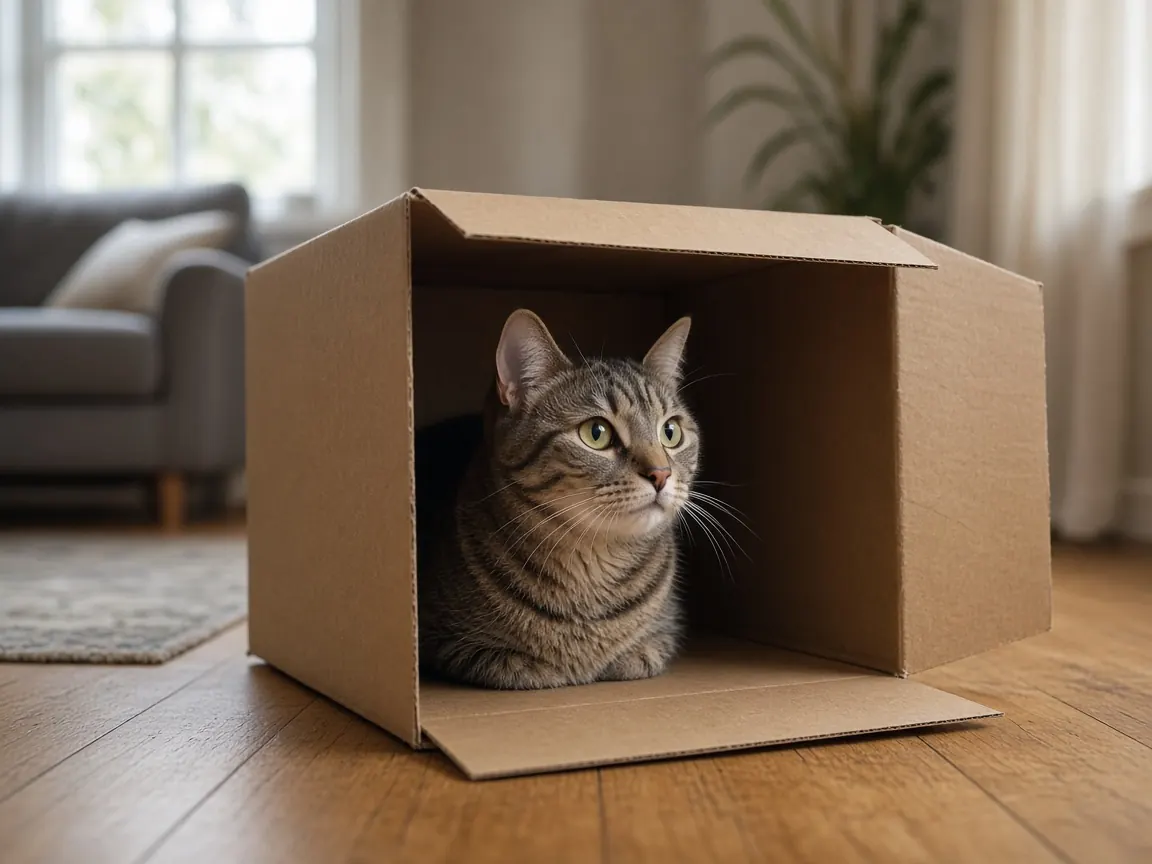
Hiding is how cats cope (Vinke, Godijn and van der Leij, 2014)
Claudia Vinke and colleagues studied 19 cats that had just arrived at a Dutch animal shelter, the moment when novelty stress is highest. The cats were randomly split into two groups: 10 got a hiding box in their pen and 9 did not. For 14 days observers scored each cat on the Kessler and Turner Cat Stress Score, a standard scale built from posture and behavior.
- Lower stress, sooner. On days 3 and 4 the hiding box group had a significantly lower mean stress score than the cats without boxes.
- A consistent effect. Stress scores in the box group varied very little between cats, so the box seemed to help most of them, while scores in the group without boxes stayed widely spread.
- Faster recovery. By day 14 both groups had reached the same level, but the box group had already got there around day 3.
The authors conclude that a hiding box appears to be an important enrichment that helps a cat cope with stressors in its first weeks in a new environment. It was a small study, and they call for more work on group housed cats and long term effects, but the direction is clear.
Hide boxes did not make cats less adoptable (Kry and Casey, 2007)
An earlier study by Krista Kry and Rachel Casey followed 43 kennelled cats at an adoption centre. Some had a Hide and Perch box as enrichment and the rest had an open bed. Over the first five days, and again on day 14 for cats still waiting, the researchers recorded stress scores, an approach test and behavior samples.
Stress fell significantly across the study days in the cats with hide boxes and kept falling between day 5 and day 14, while stress in the control group rose over the same stretch. Cats with boxes were significantly more likely to approach people and showed relaxed behavior much more often. A common worry is that a hidden cat gets overlooked, but there was no significant difference between the groups in days until adoption or in the percentage adopted. Adopters ranked temperament as their top reason for picking a cat in both groups.
Cats even sit in squares that are not really there (Smith, Chouinard and Byosiere, 2021)
Owners have long noticed cats sitting inside laundry baskets, open suitcases and squares of tape on the floor. Gabriella Smith and colleagues turned that habit into a test of visual perception. Owners printed paper shapes and placed pairs of them on the floor: a real square outline, a Kanizsa square (four Pac Man style pieces arranged so that the brain "sees" a square with no edges drawn) and a control made of the same pieces turned outward, so no square appears. Owners wore sunglasses so they could not cue their cat with their eyes.
More than 500 cat and owner pairs signed up, but only 30 finished all six daily trials, and just nine of those cats ever stepped into a shape. Across 16 choices, cats picked the real square 8 times, the illusory Kanizsa square 7 times and the control once. The authors read this as cats treating an illusory square much like a real one. With so few cats the result is a first step rather than the final word, but it suggests that the attraction to boxes is partly about outlined, enclosed looking space, not only about walls and a roof.
Why a box beats an open bed
Put the findings together and a box offers a cat several things at once: cover on most sides, a spot to watch from without being seen, and a defined space that feels like its own. The peer reviewed AAFP and ISFM Feline Environmental Needs Guidelines treat meeting a cat's environmental needs as essential, not optional, for reducing stress and stress related problems, and a safe place to retreat to is one of the needs listed on our cat care basics page.
What that means at home
- Leave a box out. A sturdy cardboard box on its side, a covered bed or a high shelf gives your cat a choice of retreat. More than one hiding spot helps in multi cat homes.
- Use boxes during change. A new home, visitors, a new pet or a new kitten are times when a hiding place matters most. Let the cat come out on its own schedule rather than pulling it out.
- Make the carrier a box the cat already likes. Leaving the carrier open at home with bedding inside turns it into a familiar hideout before vet trips.
- Watch for hiding that is new. A box loving cat is normal. A cat that suddenly hides much more than usual, stops eating or avoids people may be ill or in pain and should see a vet.
Every paper cited here is listed with its DOI on our cat research page. Related reading: cat behavior and body language and why do cats slow blink?.
Cats and boxes FAQ
Why do cats like boxes so much?
A box is a safe, enclosed hiding place. Shelter studies found that cats given a hiding box had lower stress scores and settled faster than cats without one.
Why do cats sit in squares of tape on the floor?
Cats seem drawn to outlined, enclosed looking spaces. In a 2021 citizen science study, cats sat in a real square outline and in an illusory Kanizsa square about equally often, and almost never in a control shape.
Is it bad if my cat hides in a box all the time?
Hiding in a favorite box is normal coping behavior. A sudden increase in hiding, especially with poor appetite or other changes, is a reason to see a vet.
Should I give a new cat a hiding box?
Yes. In a 2014 shelter study, newly arrived cats with a hiding box reached a low stress level by about day 3, while cats without one only caught up by the day 14 check.
Sources
- Vinke C.M., Godijn L.M., van der Leij W.J.R. (2014) Will a hiding box provide stress reduction for shelter cats? Applied Animal Behaviour Science 160:86 to 93. doi:10.1016/j.applanim.2014.09.002
- Kry K., Casey R. (2007) The effect of hiding enrichment on stress levels and behaviour of domestic cats (Felis sylvestris catus) in a shelter setting and the implications for adoption potential. Animal Welfare 16(3):375 to 383. doi:10.1017/S0962728600027196
- Smith G.E., Chouinard P.A., Byosiere S.E. (2021) If I fits I sits: A citizen science investigation into illusory contour susceptibility in domestic cats (Felis silvestris catus). Applied Animal Behaviour Science 240:105338. doi:10.1016/j.applanim.2021.105338
- Ellis S.L.H. et al. (2013) AAFP and ISFM Feline Environmental Needs Guidelines. Journal of Feline Medicine and Surgery 15(3):219 to 230. doi:10.1177/1098612X13477537
Cite this page
Students and teachers are welcome to cite this page. Add your access date if your teacher or style guide asks for one.
APA (7th ed.)
MeowWise. (2026, October 18). Why do cats like boxes? https://meowwise.com/blog/why-do-cats-like-boxes.html
MLA (9th ed.)
“Why do cats like boxes?” MeowWise, 18 Oct. 2026, meowwise.com/blog/why-do-cats-like-boxes.html.
Chicago (bibliography)
MeowWise. “Why do cats like boxes?” Last modified October 18, 2026. https://meowwise.com/blog/why-do-cats-like-boxes.html.
General education, not veterinary advice. If you are worried about your cat, contact your veterinarian; in an emergency, go to the nearest emergency vet.